


In the field of engineering, industrial manufacturing, and scientific research, accurately measuring and converting pressure values is of paramount importance. As a reputable supplier of general manometers, we understand the challenges our customers face when it comes to converting the readings of these essential instruments into different pressure units. In this blog post, we will delve into the process of converting manometer readings, providing you with a comprehensive guide to ensure precision in your pressure measurements.
Understanding General Manometers
Before we dive into the conversion process, it's crucial to have a solid understanding of what a general manometer is and how it works. A general manometer is a device used to measure pressure. It operates on the principle of balancing the pressure being measured against a column of liquid or a mechanical spring. The most common types of manometers include U-tube manometers, inclined manometers, and Bourdon tube manometers.
Our company offers a wide range of high-quality general manometers to meet the diverse needs of our customers. For instance, the Painted Steel Gas Pressure Gauge is designed for measuring gas pressure in various industrial applications. Its durable painted steel construction ensures long-term reliability, while its accurate readings make it a popular choice among professionals.
Another product in our lineup is the Conventional Pressure Gauge. This gauge is suitable for general-purpose pressure measurement in both industrial and commercial settings. It features a traditional design with a clear dial and easy-to-read scale, allowing for quick and accurate pressure readings.
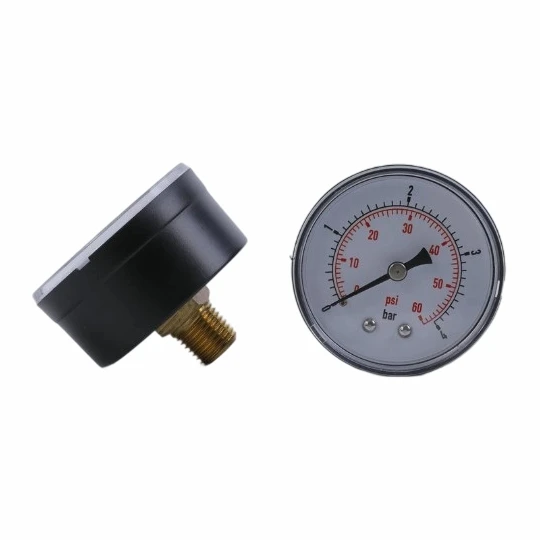
If you need a manometer for measuring air pressure, our Air Pressure Gauge with Back Connection is an excellent option. The back connection design makes it easy to install in tight spaces, while its high sensitivity ensures precise air pressure measurements.
Common Pressure Units
Pressure can be measured in various units, each with its own applications and conversion factors. Some of the most common pressure units include:
- Pascal (Pa): The SI unit of pressure, defined as one newton per square meter (N/m²). It is commonly used in scientific and engineering applications.
- Bar: A non-SI unit of pressure equal to 100,000 Pa. It is widely used in meteorology, aviation, and industrial applications.
- Pound per square inch (psi): A unit of pressure commonly used in the United States and other countries that follow the imperial system. It is defined as the pressure exerted by one pound-force per square inch of area.
- Atmosphere (atm): A unit of pressure based on the average atmospheric pressure at sea level. One atmosphere is approximately equal to 101,325 Pa or 14.7 psi.
- Torr: A unit of pressure equal to 1/760 of an atmosphere or approximately 133.322 Pa. It is commonly used in vacuum technology and medical applications.
Conversion Factors
To convert the reading of a general manometer from one pressure unit to another, you need to know the conversion factors between the units. Here are some common conversion factors:
- 1 Pa = 0.00001 bar
- 1 bar = 100,000 Pa
- 1 psi = 6894.76 Pa
- 1 atm = 101,325 Pa
- 1 torr = 133.322 Pa
Conversion Process
The process of converting the reading of a general manometer to other pressure units involves the following steps:
- Determine the original pressure unit: Identify the pressure unit in which the manometer reading is given. This information is usually indicated on the manometer dial or in the product specifications.
- Select the desired pressure unit: Decide which pressure unit you want to convert the reading to. Consider the requirements of your application and the industry standards you need to follow.
- Find the conversion factor: Look up the conversion factor between the original pressure unit and the desired pressure unit. You can use the conversion factors provided above or refer to a pressure conversion table.
- Perform the conversion: Multiply the manometer reading by the conversion factor to obtain the equivalent pressure in the desired unit. For example, if you have a manometer reading of 50 psi and you want to convert it to Pa, you would multiply 50 by 6894.76, which gives you 344,738 Pa.
Example Conversions
Let's look at some examples of converting manometer readings to different pressure units:
- Example 1: Converting from psi to Pa
- Manometer reading: 25 psi
- Conversion factor: 1 psi = 6894.76 Pa
- Calculation: 25 psi x 6894.76 Pa/psi = 172,369 Pa
- Example 2: Converting from bar to atm
- Manometer reading: 1.5 bar
- Conversion factor: 1 bar = 0.986923 atm
- Calculation: 1.5 bar x 0.986923 atm/bar = 1.480385 atm
- Example 3: Converting from torr to Pa
- Manometer reading: 300 torr
- Conversion factor: 1 torr = 133.322 Pa
- Calculation: 300 torr x 133.322 Pa/torr = 39,996.6 Pa
Tips for Accurate Conversion
To ensure accurate conversion of manometer readings, keep the following tips in mind:
- Use reliable conversion factors: Make sure you use accurate and up-to-date conversion factors. You can find reliable conversion factors in scientific textbooks, online resources, or pressure conversion calculators.
- Pay attention to significant figures: When performing calculations, round your final answer to the appropriate number of significant figures. The number of significant figures in your answer should be consistent with the precision of the original manometer reading.
- Check your work: Double-check your calculations to avoid errors. You can use a calculator or a spreadsheet program to perform the calculations and verify your results.
Conclusion
Converting the reading of a general manometer to other pressure units is a straightforward process that requires a basic understanding of pressure units and conversion factors. By following the steps outlined in this blog post and using the tips provided, you can ensure accurate and reliable pressure measurements in your applications.
As a leading supplier of general manometers, we are committed to providing our customers with high-quality products and excellent customer service. If you have any questions about our manometers or need assistance with pressure conversion, please don't hesitate to contact us. We look forward to working with you and helping you meet your pressure measurement needs.

References
- Young, H. D., & Freedman, R. A. (2012). University Physics with Modern Physics (13th ed.). Pearson.
- Halliday, D., Resnick, R., & Walker, J. (2013). Fundamentals of Physics (10th ed.). Wiley.
- Serway, R. A., & Jewett, J. W. (2013). Physics for Scientists and Engineers with Modern Physics (9th ed.). Cengage Learning.


