


What is the pressure linearity of an ordinary pressure gauge?
As a supplier of ordinary pressure gauges, I often encounter questions from customers about the technical aspects of these instruments. One of the most frequently asked questions is about pressure linearity. In this blog post, I'll explain what pressure linearity is, why it matters, and how it relates to the ordinary pressure gauges we supply.
Understanding Pressure Linearity
Pressure linearity refers to the relationship between the input pressure and the output indication of a pressure gauge. In an ideal world, the output of a pressure gauge would increase or decrease in a perfectly straight - line fashion as the input pressure changes. That is, for every unit increase in pressure, the gauge's reading would increase by a constant amount.
Mathematically, if we plot the pressure applied to the gauge on the x - axis and the corresponding gauge reading on the y - axis, a perfectly linear pressure gauge would produce a straight line. The equation of this line can be represented as (y = mx + b), where (y) is the gauge reading, (x) is the actual pressure, (m) is the slope of the line (representing the gauge's sensitivity), and (b) is the y - intercept (which is typically zero in a well - calibrated gauge).
However, in reality, no pressure gauge is perfectly linear. There are always some deviations from the ideal straight - line relationship. These deviations can be caused by a variety of factors, including the mechanical properties of the gauge's components, such as the elasticity of the Bourdon tube (a common sensing element in ordinary pressure gauges), friction in the movement mechanism, and temperature effects.
Why Pressure Linearity Matters
The linearity of a pressure gauge is crucial for accurate pressure measurement. In many industrial applications, precise pressure control is essential for the safe and efficient operation of equipment. For example, in a chemical processing plant, incorrect pressure readings due to poor linearity could lead to over - or under - pressurization of reaction vessels, which may result in equipment damage, product quality issues, or even safety hazards.
In addition, linearity affects the calibration and accuracy of the pressure gauge. When a gauge is calibrated, technicians rely on the assumption of a relatively linear relationship between the input pressure and the output reading. If the gauge has poor linearity, it becomes more difficult to calibrate accurately, and the calibration may not hold over a wide range of pressures.
Pressure Linearity in Ordinary Pressure Gauges
Ordinary pressure gauges, such as the Conventional Pressure Gauge, Steel Chrome Plated Presssure Gauge, and Air Pressure Gauge with Back Connection that we supply, are designed to provide a reasonable level of linearity within their specified operating ranges.
The design of the gauge's sensing element plays a significant role in determining its linearity. For instance, Bourdon tube pressure gauges are widely used due to their relatively good linearity characteristics. The Bourdon tube is a curved, hollow tube that straightens when pressure is applied. As it straightens, it moves a linkage mechanism that rotates the gauge's pointer. The shape and material of the Bourdon tube are carefully selected to minimize non - linearities.
Manufacturers also take steps during the production process to improve linearity. This includes precise machining of the gauge's components to reduce friction and ensure smooth movement, and careful calibration to correct for any inherent non - linearities. However, it's important to note that the linearity of a pressure gauge can degrade over time due to factors such as wear and tear, corrosion, and exposure to extreme temperatures.
Measuring and Specifying Pressure Linearity
The linearity of a pressure gauge is typically specified as a percentage of the full - scale reading. For example, a gauge with a linearity specification of ±1% of full - scale means that the maximum deviation from the ideal straight - line relationship is 1% of the gauge's full - scale pressure range.
To measure the linearity of a pressure gauge, a calibration process is carried out using a known pressure source. The pressure is gradually increased in small increments, and the corresponding gauge readings are recorded. These readings are then plotted against the known pressures, and the deviation from the best - fit straight line is calculated.
It's important for customers to understand the linearity specification of the pressure gauge they are purchasing. A gauge with a higher linearity specification (i.e., a lower percentage deviation) will generally provide more accurate and reliable pressure measurements, but it may also be more expensive.
Our Commitment as a Supplier
As a supplier of ordinary pressure gauges, we are committed to providing our customers with high - quality products that offer good pressure linearity. We work closely with our manufacturers to ensure that the gauges we supply meet strict quality standards. Our quality control team conducts thorough inspections and calibrations before the gauges are shipped to our customers.
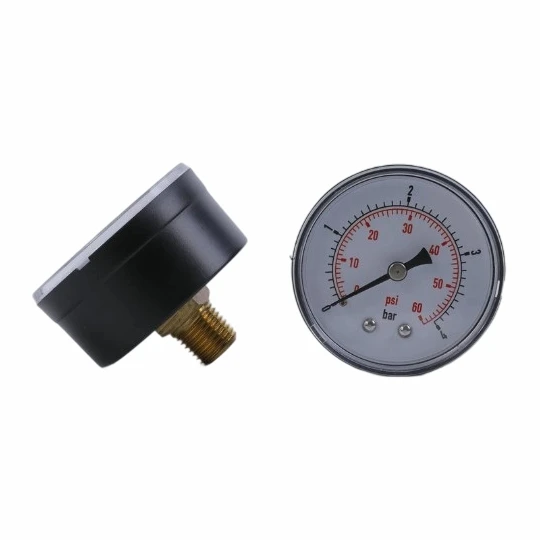

We also offer technical support to our customers. If you have any questions about pressure linearity or need help selecting the right pressure gauge for your application, our team of experts is here to assist you. We can provide detailed information about the linearity specifications of our products and help you understand how they will perform in your specific operating conditions.
Conclusion
Pressure linearity is an important characteristic of ordinary pressure gauges. It affects the accuracy and reliability of pressure measurements, which are crucial in many industrial applications. While no pressure gauge is perfectly linear, modern manufacturing techniques and careful calibration can ensure that the gauges we supply offer a reasonable level of linearity within their specified operating ranges.
If you are in the market for an ordinary pressure gauge and are concerned about pressure linearity, we encourage you to contact us. Our experienced team can help you select the right gauge for your needs and provide you with all the information you need to make an informed decision. Whether you require a Conventional Pressure Gauge, Steel Chrome Plated Presssure Gauge, or Air Pressure Gauge with Back Connection, we have the expertise and products to meet your requirements. Let's start a conversation about your pressure measurement needs and find the best solution together.
References
- "Pressure Measurement Handbook", CRC Press
- "Instrumentation and Control Systems", Butterworth - Heinemann


