


When it comes to pressure gauges, brass pressure gauges are a popular choice in various industries due to their durability, corrosion resistance, and accuracy. As a supplier of brass pressure gauges, I often receive inquiries about how the size of these gauges can affect their performance. In this blog post, I will delve into the relationship between the size of a brass pressure gauge and its performance, exploring the advantages and considerations associated with different gauge sizes.
Understanding the Basics of Brass Pressure Gauges
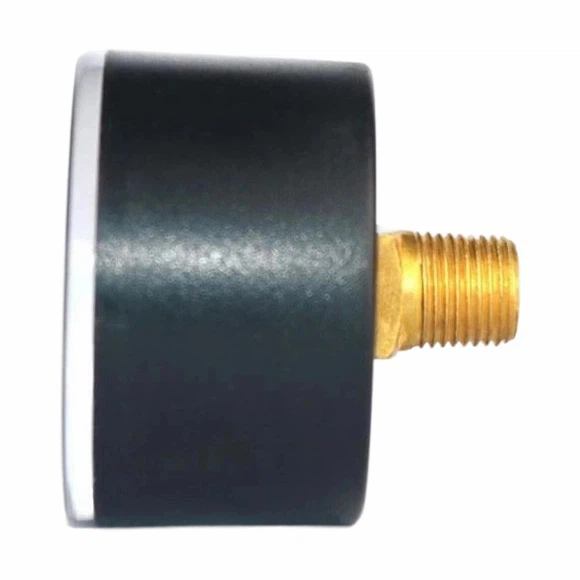
Before we discuss the impact of size on performance, let's briefly review the basic components and functions of a brass pressure gauge. A typical brass pressure gauge consists of a bourdon tube, a movement mechanism, a dial, and a pointer. The bourdon tube, which is made of brass or other materials, is the primary sensing element that converts pressure into mechanical displacement. When pressure is applied to the bourdon tube, it undergoes a change in shape, which is transmitted to the movement mechanism. The movement mechanism then translates this mechanical displacement into rotational motion, causing the pointer to move across the dial and indicate the pressure reading.
Impact of Size on Accuracy
One of the key factors affected by the size of a brass pressure gauge is its accuracy. Generally speaking, larger pressure gauges tend to offer higher accuracy compared to smaller ones. This is because larger gauges have a larger bourdon tube, which provides a greater mechanical displacement for a given pressure change. As a result, the movement mechanism can more precisely translate this displacement into a corresponding pressure reading on the dial.
For example, a larger brass pressure gauge with a 6-inch diameter may have a higher accuracy class, such as ±0.5% or ±1%, compared to a smaller gauge with a 2.5-inch diameter, which may have an accuracy class of ±1.5% or ±2%. This difference in accuracy can be crucial in applications where precise pressure measurements are required, such as in the pharmaceutical, food and beverage, and aerospace industries.
However, it's important to note that accuracy is not solely determined by the size of the gauge. Other factors, such as the quality of the materials, the manufacturing process, and the calibration of the gauge, also play significant roles in determining its accuracy. Therefore, when selecting a brass pressure gauge, it's essential to consider the specific accuracy requirements of your application and choose a gauge that meets or exceeds those requirements.
Impact of Size on Readability
Another important consideration when it comes to the size of a brass pressure gauge is its readability. Larger gauges typically have larger dials and pointers, which make it easier to read the pressure readings from a distance. This can be particularly beneficial in industrial settings where operators may need to monitor pressure levels from a distance or in low-light conditions.
For instance, in a large manufacturing plant, operators may need to read pressure gauges located on equipment that is several feet away. In such cases, a larger brass pressure gauge with a clear and easy-to-read dial can significantly improve the efficiency and safety of the operation. On the other hand, smaller gauges may be more suitable for applications where space is limited or where the gauge needs to be installed in a confined area.

Impact of Size on Durability
The size of a brass pressure gauge can also affect its durability. Larger gauges generally have a more robust construction, which makes them more resistant to mechanical shock, vibration, and environmental factors. This is because larger gauges have a larger housing and more substantial internal components, which can better withstand the stresses and strains of industrial applications.
For example, in a hydraulic system where high-pressure fluctuations and vibrations are common, a larger brass pressure gauge may be more suitable than a smaller one. The larger gauge's sturdy construction can help prevent damage to the bourdon tube and other internal components, ensuring reliable and accurate pressure measurements over an extended period of time.
However, it's important to note that durability is not only determined by the size of the gauge. The quality of the materials used in the construction of the gauge, such as the brass alloy and the protective coatings, also play a crucial role in determining its durability. Therefore, when selecting a brass pressure gauge, it's important to choose a gauge that is made from high-quality materials and has a proven track record of durability in similar applications.
Impact of Size on Cost
The size of a brass pressure gauge can also have an impact on its cost. Generally speaking, larger gauges tend to be more expensive than smaller ones. This is because larger gauges require more materials and more complex manufacturing processes, which increase the production cost.
In addition, larger gauges may also require more space for installation, which can add to the overall cost of the system. For example, in a compact industrial control panel, a larger pressure gauge may not fit, requiring the installation of a custom-made panel or the relocation of other components.
However, it's important to consider the long-term cost benefits of using a larger brass pressure gauge. While the initial cost may be higher, the improved accuracy, readability, and durability of the larger gauge can result in lower maintenance costs, reduced downtime, and increased productivity over the life of the gauge. Therefore, when evaluating the cost of a brass pressure gauge, it's essential to consider the total cost of ownership rather than just the initial purchase price.
Applications and Considerations
The choice of the size of a brass pressure gauge ultimately depends on the specific requirements of your application. Here are some common applications and considerations for different gauge sizes:
- Small Gauges (2.5 - 3.5 inches): Small brass pressure gauges are often used in applications where space is limited, such as in automotive engines, HVAC systems, and small industrial equipment. They are also suitable for applications where cost is a major concern and where high accuracy is not critical. For example, in a home HVAC system, a small brass pressure gauge can provide a basic indication of the refrigerant pressure, which is sufficient for most maintenance and troubleshooting purposes.
- Medium Gauges (4 - 5 inches): Medium-sized brass pressure gauges are a popular choice for a wide range of industrial applications, including hydraulic systems, pneumatic systems, and process control systems. They offer a good balance between accuracy, readability, and cost, making them suitable for applications where moderate accuracy and readability are required. For example, in a hydraulic press, a medium-sized brass pressure gauge can provide accurate pressure measurements to ensure the proper operation of the press.
- Large Gauges (6 inches and above): Large brass pressure gauges are typically used in applications where high accuracy and excellent readability are essential, such as in the oil and gas, power generation, and aerospace industries. They are also suitable for applications where the gauge needs to be monitored from a distance or in low-light conditions. For example, in a power plant, a large brass pressure gauge can be installed on a high-pressure steam line to provide operators with a clear and accurate indication of the steam pressure.
Conclusion
In conclusion, the size of a brass pressure gauge can have a significant impact on its performance, including accuracy, readability, durability, and cost. When selecting a brass pressure gauge, it's important to consider the specific requirements of your application and choose a gauge that meets or exceeds those requirements. Larger gauges generally offer higher accuracy, better readability, and greater durability, but they may also be more expensive and require more space for installation. Smaller gauges, on the other hand, are more suitable for applications where space is limited or where cost is a major concern.
As a supplier of brass pressure gauges, we offer a wide range of sizes and specifications to meet the diverse needs of our customers. Whether you need a small gauge for a compact application or a large gauge for a high-precision measurement, we have the expertise and the products to provide you with the right solution. If you have any questions or need assistance in selecting the appropriate brass pressure gauge for your application, please don't hesitate to contact us for procurement and negotiation. We look forward to working with you to meet your pressure measurement needs.
References
- ASME B40.100 - Pressure Gauges and Gauge Attachments
- ISO 5167 - Measurement of fluid flow by means of pressure differential devices inserted in circular cross-section conduits running full
- OMEGA Engineering - Pressure Gauge Selection Guide


