


Hey there! As a supplier of conventional pressure gauges, I've seen firsthand how important it is to choose the right one for your needs. With so many options out there, it can be a bit overwhelming. But don't worry, I'm here to break it down for you and help you make an informed decision.
Understanding Your Needs
First things first, you need to figure out what you'll be using the pressure gauge for. Are you measuring the pressure of a liquid, a gas, or something else? Different substances have different properties, and you'll need a gauge that can handle them. For example, if you're dealing with a corrosive liquid, you'll need a gauge made from a material that won't corrode easily.
Think about the pressure range you'll be working with. Is it a low-pressure application, like measuring the air pressure in a tire? Or is it a high-pressure situation, such as in an industrial hydraulic system? Knowing the pressure range is crucial because you need a gauge that can accurately measure within that range. If you choose a gauge with a too-low pressure rating, it could get damaged or give inaccurate readings. On the other hand, a gauge with a much higher rating than you need might not be as precise.
Types of Conventional Pressure Gauges
There are several types of conventional pressure gauges available, and each has its own advantages. Let's take a look at some common ones.
Bourdon Tube Pressure Gauges
These are probably the most widely used type of pressure gauges. They work based on the principle that a flattened tube will try to straighten when pressure is applied inside it. This movement is then translated into a reading on the gauge dial. Bourdon tube gauges are known for their reliability and accuracy. They can handle a wide range of pressures, from low to very high. They're commonly used in industrial applications, like in boilers, compressors, and pipelines.
Diaphragm Pressure Gauges
Diaphragm gauges use a flexible diaphragm that moves when pressure is applied. This movement is measured and displayed on the gauge. They're great for measuring low pressures, especially in applications where the pressure may fluctuate. Diaphragm gauges are often used in the food and beverage industry, as well as in medical equipment, because they can be made from materials that are hygienic and non - reactive.
Bellows Pressure Gauges
Bellows gauges use a bellows - shaped element that expands or contracts with changes in pressure. They're sensitive and can measure very low pressures accurately. They're commonly used in applications where precise low - pressure measurements are required, such as in vacuum systems or in some laboratory equipment.
Material Considerations
The material of the pressure gauge is another important factor. It needs to be compatible with the substance whose pressure you're measuring.
Brass Pressure Gauge
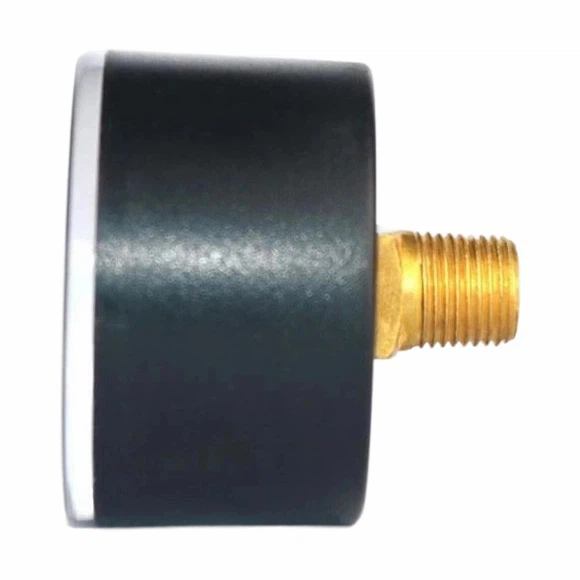
Brass is a popular choice for pressure gauges. It's relatively inexpensive, easy to machine, and has good corrosion resistance. Brass Pressure Gauge is suitable for many general - purpose applications, especially those involving non - corrosive gases and liquids. However, if you're dealing with a highly corrosive environment, brass might not be the best option.
Painted Steel Gas Pressure Gauge
Painted steel gauges are often used for measuring gas pressures. The paint provides some protection against corrosion. Painted Steel Gas Pressure Gauge is a cost - effective option for many industrial and commercial applications. But keep in mind that the paint can chip or wear over time, exposing the steel to potential corrosion.
Stainless Steel Pressure Gauges
Stainless steel is a great choice for applications where corrosion is a concern. It can withstand harsh environments, including exposure to chemicals and high humidity. Stainless steel pressure gauges are commonly used in the chemical, pharmaceutical, and marine industries.

Accuracy and Resolution
Accuracy is how close the gauge reading is to the actual pressure. Resolution, on the other hand, is the smallest change in pressure that the gauge can detect. When choosing a pressure gauge, you need to consider both.
For most general - purpose applications, an accuracy of ±1% or ±2% is usually sufficient. But in some industries, like aerospace or high - precision manufacturing, you might need a gauge with much higher accuracy, such as ±0.1% or even better.
The resolution of the gauge depends on its design and the size of the dial. A larger dial usually allows for better resolution, as it can display smaller increments of pressure.
Dial Size and Readability
The size of the gauge dial matters, especially if you need to read the pressure from a distance. A larger dial is generally easier to read, but it might also take up more space. In industrial settings, where operators need to quickly check the pressure, a larger dial can be a big advantage.
Consider the lighting conditions where the gauge will be used. If it's in a dimly lit area, you might want a gauge with a backlit dial or large, easy - to - read numbers.
Connection Type
The connection type of the pressure gauge is important for proper installation. There are different types of connections, such as threaded connections, flange connections, and quick - connect fittings.
Make sure the connection type of the gauge matches the connection on your system. For example, if your pipeline has a specific thread size, you need to choose a gauge with the same thread size. Using the wrong connection type can lead to leaks or improper installation.
Additional Features
Some pressure gauges come with additional features that can be useful. For example, some gauges have a shock - resistant case, which is great for applications where the gauge might be exposed to vibrations or impacts. Others have a temperature compensation feature, which helps to ensure accurate readings even when the temperature changes.
If you need to monitor the pressure over time, you might want a gauge with a memory function or a data - logging capability. These features can be very useful in quality control and process monitoring applications.
Pressure Measuring Pressure Gauge
When it comes to measuring pressure accurately, our Pressure Measuring Pressure Gauge is a great option. It's designed to provide reliable and precise readings in a variety of applications. Whether you're in the industrial, commercial, or even residential sector, this gauge can meet your needs.
Making the Right Choice
Now that you know all these factors, you're well on your way to choosing the right conventional pressure gauge. Take your time to evaluate your needs, compare different options, and don't be afraid to ask for advice. As a supplier, I'm always here to help you make the best decision for your specific situation.
If you're interested in purchasing a conventional pressure gauge, I encourage you to get in touch with us. We have a wide range of gauges to choose from, and we can work with you to find the perfect one for your application. Whether you need a single gauge or a large quantity for your business, we can assist you.
References
- "Handbook of Pressure Gauge Technology"
- "Industrial Pressure Measurement: Principles and Applications"
- Manufacturer's specifications and technical documents for pressure gauges


