


When it comes to selecting the best mounting option for a general air pressure gauge, there are several factors to consider. As a supplier of general air pressure gauges, I understand the importance of making the right choice to ensure accurate measurements and long - term reliability. In this blog, I'll guide you through the process of choosing the most suitable mounting option for your specific needs.
Understanding the Basics of Air Pressure Gauges
Before delving into the mounting options, it's essential to have a basic understanding of air pressure gauges. These instruments are designed to measure the pressure of air or other gases in a system. They come in various types, including analog and digital, and are used in a wide range of applications, from industrial processes to automotive systems.
A Pressure Measuring Pressure Gauge is a common type of air pressure gauge that provides a visual indication of the pressure within a system. It typically consists of a dial, a pointer, and a pressure - sensing element. The accuracy and reliability of the gauge depend on the quality of its components and the proper installation.
Factors to Consider When Choosing a Mounting Option
1. Application Environment
The environment in which the air pressure gauge will be used is a crucial factor in determining the mounting option. For example, if the gauge is to be installed in a harsh industrial environment with high levels of vibration, shock, or dust, a more robust mounting option may be required. In such cases, a panel - mount or a flush - mount option can provide better stability and protection.
On the other hand, if the gauge is used in a clean and controlled environment, such as a laboratory or an office, a surface - mount option may be sufficient. This type of mounting is relatively easy to install and allows for easy access to the gauge for reading and maintenance.
2. Accessibility
Accessibility is another important consideration. You need to ensure that the gauge can be easily read and adjusted if necessary. If the gauge is installed in a hard - to - reach location, it may be difficult to monitor the pressure accurately. In such cases, a remote - mount option or a gauge with a flexible connection can be a better choice.
For example, in a large industrial plant, where the pressure - sensing point is far from the control room, a remote - mount pressure gauge can be installed near the control panel, allowing operators to monitor the pressure without having to visit the actual measurement location.
3. Space Constraints
The available space for installing the air pressure gauge is also a significant factor. In some applications, there may be limited space, especially in compact equipment or machinery. In such cases, a small - sized gauge with a suitable mounting option, such as a direct - mount or a side - mount, may be required.
For instance, in a small automotive engine compartment, where space is at a premium, a side - mount air pressure gauge can be installed without taking up too much space.
4. Compatibility with the System
The mounting option should be compatible with the existing system. This includes ensuring that the gauge can be properly connected to the pressure source and that the mounting hardware is suitable for the system's structure.
For example, if the system has a specific type of pipe or fitting, the air pressure gauge should have a compatible connection type. A Air Pressure Gauge with Back Connection can be a good choice if the system requires a back - mounted connection for easy integration.
Common Mounting Options for Air Pressure Gauges
1. Panel - Mount
Panel - mount air pressure gauges are designed to be installed on a panel or a control board. They are typically secured using nuts or screws and provide a stable and professional - looking installation. Panel - mount gauges are suitable for applications where the gauge needs to be easily visible and accessible, such as in control rooms or instrument panels.
The advantage of panel - mount gauges is that they can be neatly arranged on a panel, making it easier to monitor multiple gauges at once. However, they may require some drilling and wiring, which can be time - consuming during installation.
2. Surface - Mount
Surface - mount air pressure gauges are installed directly on a flat surface, such as a wall or a machine housing. They are usually attached using adhesive or screws. Surface - mount gauges are easy to install and are suitable for applications where the gauge does not need to be recessed or integrated into a panel.

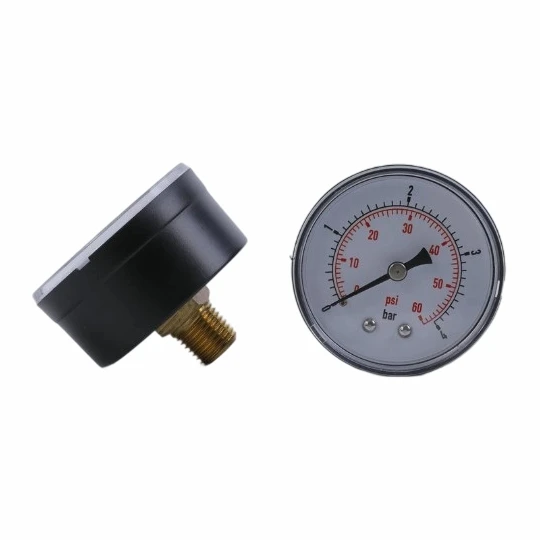
This type of mounting is ideal for applications where quick installation is required or where the gauge needs to be moved or re - positioned easily. However, surface - mount gauges may not provide as much protection as panel - mount gauges in harsh environments.
3. Flush - Mount
Flush - mount air pressure gauges are installed so that the face of the gauge is flush with the surface of the panel or the equipment. They provide a clean and streamlined appearance and are suitable for applications where aesthetics are important. Flush - mount gauges are often used in high - end equipment or in applications where the gauge needs to be integrated seamlessly into the design.
The installation of flush - mount gauges can be more complex than other mounting options, as it requires precise cutting and fitting. However, they offer good protection against dust and debris and can be more visually appealing.
4. Direct - Mount
Direct - mount air pressure gauges are installed directly onto the pressure source, such as a pipe or a fitting. They are typically connected using a threaded connection and provide a simple and straightforward installation. Direct - mount gauges are suitable for applications where the gauge needs to be located close to the pressure - sensing point.
The advantage of direct - mount gauges is that they can provide more accurate pressure measurements, as there is less chance of pressure loss due to long connections. However, they may be more difficult to access for maintenance and replacement.
5. Side - Mount
Side - mount air pressure gauges are installed on the side of a panel or a piece of equipment. They are useful in applications where space is limited or where the gauge needs to be installed in a specific orientation. Side - mount gauges can be easily adjusted and read from the side, making them suitable for applications where the front of the gauge is not easily accessible.
Choosing the Right Gauge for the Mounting Option
In addition to choosing the right mounting option, it's also important to select the appropriate air pressure gauge for your application. A Painted Steel Gas Pressure Gauge is a popular choice for many applications due to its durability and corrosion resistance.
When selecting a gauge, consider the following factors:
- Pressure Range: Choose a gauge with a pressure range that is suitable for your application. The gauge should be able to measure the minimum and maximum pressure values accurately.
- Accuracy: The accuracy of the gauge is crucial, especially in applications where precise pressure measurements are required. Look for gauges with a high level of accuracy, such as ±1% or ±0.5%.
- Size and Dial: The size and dial of the gauge should be appropriate for the application. A larger dial may be easier to read, especially in applications where the gauge is located at a distance.
Conclusion
Choosing the best mounting option for a general air pressure gauge is a critical decision that can affect the accuracy, reliability, and ease of use of the gauge. By considering factors such as the application environment, accessibility, space constraints, and compatibility with the system, you can select the most suitable mounting option for your needs.
As a supplier of general air pressure gauges, we offer a wide range of gauges and mounting options to meet your specific requirements. If you are looking for high - quality air pressure gauges and need assistance in choosing the right mounting option, please feel free to contact us. We are here to help you make the best decision for your application.
References
- ASME B40.100 - 2013, Pressure Gauges and Gauge Attachments
- ISO 9001:2015, Quality Management Systems - Requirements


